Showing posts with label stone age animation. Show all posts

Thursday, March 14, 2013

Storyboards of the Ages

A few months ago, I wrote a post about ancient animations.  Apparently, just because they were limited to painting with mineral pigments on cave walls, that was no reason for early cave painters not to dream of ways that their pictures might move.

Howard Terpning's classic painting, The Storyteller
I've always believed that storytelling is one of the oldest art forms in the human repertoire, so it's not surprising that artists intent on telling stories should have come up with what we call a storyboard, to tell tales of linear sequences of events.

The term "storyboard" apparently originated at the Walt Disney Studios during the 1930s, but the idea of a sequence of images that tell a story is much, much older.

Some of the earliest examples I've been able to find come from Egyptian tombs.  There is a particularly well-preserved tomb in Thebes from the 18th Dynasty: that of Menna, whose title was Superintendent of the Estates of the King and of Amen.

As Superintendent of the Estates, part of his job was to oversee various projects for his master, and these were lavishly illustrated on the walls of his tomb.  Here's the one for the harvest:
The tomb mural Harvest shows ancient Egyptian harvesting methods in a storyboard-like sequence.
The Column of Marcus Aurelius in Rome, finished ca. 193
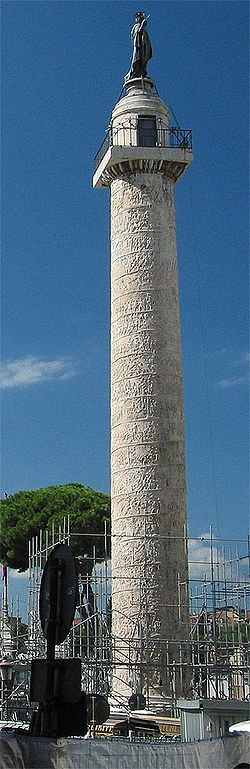
Trajan's Column, 113 CE
Some of the all-time top champion storyboarders of the ancient world were the Romans.  

The distinctly phallic triumphal columns dedicated to Emperors Trajan and Marcus Aurelius feature elaborate, realistically carved sequences depicting the highlights of their respective campaigns of conquest.

As you may be able to see from the photos of the two columns, they feature a winding spiral of images, going up like a "spiral storycase" from bottom to top.
This is a detail from the Column of Marcus Aurelius, showing the army and some of its plunder.
Not surprisingly, it's pretty hard to see the details of all the panels when you're squinting into the Roman sunlight, looking up at the original columns.  This viewing difficulty inspired several efforts in the 19th and 20th centuries to create plaster casts that could be viewed more comfortably. A beautiful set of casts from Trajan's Column is on display at the Museum of Roman Civilization, presented up-close and at eye level, so you don't have to miss a thing.
The Museum of Roman Civilization in Rome has plaster casts of each panel on Trajan's Column displayed in correct sequence at eye-level, so visitors can see them more easily and in more detail.
  
IMAGES: Many thanks to Robert Milliman's blog, "Also Out of My Mind!" for the image of Howard Terpning's The Storyteller. The photo of part of the Egyptian tomb mural Harvest is from the blog "A History of Graphic Design," by Guity Novin. Wikipedia provided the full-length images of Trajan's Column and the Column of Marcus AureliusParadoxplace provided the detail from the Column of Marcus Aurelius, and Wikipedia provided the image of the Museum of Roman Culture's plaster castings of Trajan's Column.  My deepest gratitude to all!  

Thursday, July 12, 2012

Ancient Animations

   I was fascinated to discover an article in a recent issue of Science News, titled "Stone Age Artists Produced Movies," by Bruce Bower.
   Well, not movies as we know them.  But the Stone Age artists left rudimentary animations on the walls of several European caves. Archaeologist Marc Azema (University of Toulouse-Le Mirail, France), whose work was spotlighted in the Science News article, has created a wonderful animation, showing an interesting collection of them (via YouTube):


Archaeologist Marc Azema has created several films on cave
art animations.

   Azema has been involved in a number of film and animation projects, and has been a presenter at the Annecy International Animation Film Festival as well as other places.
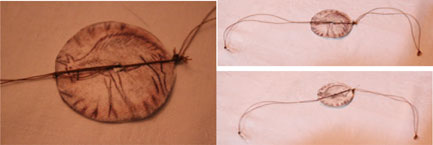
   The Science News article also included photos of a bone disk, engraved on both sides (one shows a standing deer, the other a deer with its legs drawn up under it). Stringing an animal sinew through a hole drilled in the middle and spinning it creates an optical illusion of the deer jumping or lying down (depending on your interpretation).
   This is called a thaumatrope. The idea was re-invented in the 19th century; thaumatropes were popular toys in Victorian times, but not many realized until recently that Stone Age Europeans used them too. 
   I took the images of both sides of the bone disk, using photos printed in my copy of the magazine, glued them to cardboard, and tied them with upholstery thread to simulate the sinew.  It works pretty well.
I hope you can see the images on my homemade thaumatrope, made from photos
originally published in the print version of the Science News  article. 
   A much more recent animation was discovered on a 5,200-year-old Iranian cup--until recently thought to be the world's oldest animation (though it can't compete with Chauvet Cave's 30,000-32,000-year age). I have been unable to get my Blogger interface to let me embed the "jumping wild goat" animation (Go to Major Durant's Photobucket page to see that), but here's a look at the sequence of images on the footed bowl/cup:
Here is the sequence painted along the rim of the 5,200-year-old bowl.
An archaeologist holds the ancient bowl in a CHN photo.
I had a great time looking at these, and I hope you enjoy them, too!


PHOTO CREDITS: Many thanks to Marc Azema for the YouTube video of the cave animations. The photo of M. Azema in his element is from the Annecy International Animated Film Festival's online 2012 archive. My son Ty Gephardt took the photos of my homemade thaumatrope. The images from the rim of the Iranian bowl are from the Circle of Ancient Iranian Studies website, and the image of the bowl itself is from T. Lee Harris's "Comments from the Peanut Gallery" blog. My gratitude goes to all! Please go look at their sites for more cool information.