Wednesday, January 9, 2013

Life Catches Up, with a Vengeance!

I really must apologize to anyone who has grown tired of checking back for updates . . . we've had several simultaneous family crises (starting at Thanksgiving, and continuing through now).

In my diminished time leftover from dealing with them, I have made notes on about half-a-dozen posts I'd like to write, but spent more of it making art than writing about it.

As soon as possible, I'll write a post about creating Rose Dance.

The Nine-Part Herbal Fantasy is still in the works, but likely to become a diptych.

Coming Through! is a new multiple original that debuted at the Holiday Visual Feast.

That's a sample. I've also seen some galleries I'd like to write about, and there are other developments, as well.

Stay tuned. This family stuff can't go on forever!

Thursday, November 22, 2012

One step forward, two steps back

Seems like just when you think things are looking up, it's time for another look.

Choice: Accept or Reject by Yu Chang
The "obscene" statue that isn't
I recently was pleased to see that the grand jury convened to decide whether an Overland Park Arboretum statue (subject of one of my previous posts) was obscene or not, had taken very little time to decide it is NOT.

Choice: Accept or Reject, by Yu Chang, had been the subject of hot controversy earlier this year, when a group of local fundamentalists aligned with the American Family Association circulated a petition to have it removed. They said it was obscene because the female subject was only partially clothed.

From the beginning, Overland Park officials denied that there was anything "obscene" about this work, and resisted the idea of removing it. The AFA group, however, was able to collect enough signatures to require that a grand jury be convened.

Thank goodness the grand jury had the excellent sense to deal quickly with this nuisance complaint. The group was demanding that the sculpture be removed, but certainly not doing any fundraising to support such a large public expense. I'm sure they aren't planning to pay for the cost of empaneling the grand jury, either.

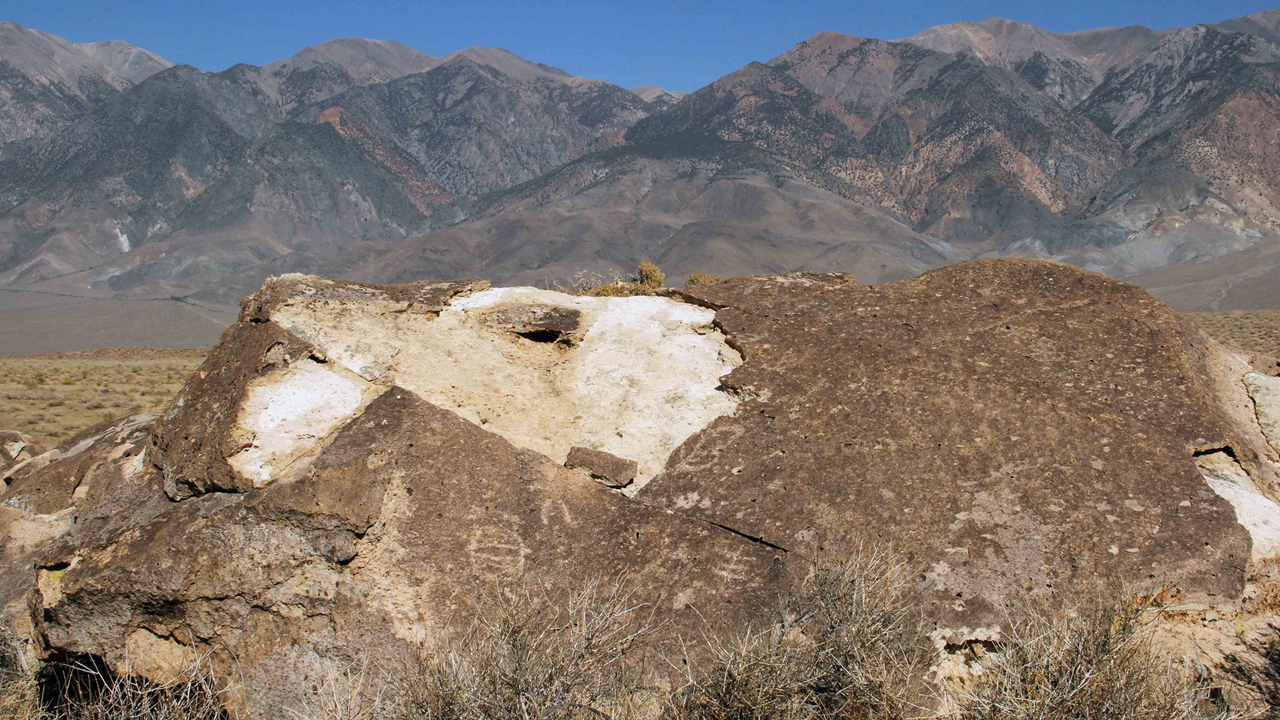
Cement saws left obscene scars in the looters' wake.
A horrifying case of theft and vandalism in a sacred place
Not all the recent news about art in public life has been good, however, I was horrified to learn of the recent theft of four ancient petroglyphs from a site near Bishop, CA.

Stealing a petroglyph is no easy feat--and in this case it was done with all the finesse of a smash-and-grab, by a well-organized gang of looters who left ugly gashes, saw cuts and hammer marks--as well as one broken and abandoned petroglyph--in their wake.

The 3500-year-old petroglyphs were part of a site on the National Register of Historic Places, in the Volcanic Tableland area. Greg Haverstock, a Bureau of Land Management archaeologist described it as "the worst act of vandalism ever seen" at the BLM site, in a story posted by the LA Times.

All they left here was an ugly scar.
The site is a sacred place to the Paiute-Shoshone tribal members in the area, so it is as if the thieves had looted an ancient temple or cathedral. While not quite on the scale of the destruction of the Buddhas of Bamiyan, this senseless act--priceless treasures hacked to pieces for a potential market value of maybe $500 to $1500--leaves me feeling angry and violated. I can only imagine how the Paiutes and Shoshones must feel.

I don't normally like to use profanity on this blog, but fellow blogger Marina Galperina got it just right when she described these looters as "assholes with chainsaws." I hope the BLM catches up to them quickly, and nails them with every penalty possible.

Meanwhile, happy Thanksgiving.

PHOTO CREDITS: The Fred Blocher photo of Choose: Accept or Reject is from the Kansas City Star's Johnson County 913 magazine. The image of the petroglyph with saw marks is from the Bureau of Land Management, via the New York Daily News. Finally, the hacked-off rock photo came from Maria Galperina. Many thanks to all!


Thursday, October 25, 2012

Not quite ready, yet!

Anton's wasn't open when we visited--but soon!
Several weeks ago I saw an article in the Kansas City Star (somehow the link is now gone!), about a new gallery above a restaurant in the KC Crossroads.

Called the Main Street Gallery, it was to be on the second story of a place named Anton's Taproom at 1610 Main, Kansas City, MO. The article said the gallery was open during the restaurant's business hours.

What fun, I thought, and made arrangements with a friend to have lunch there around the end of the month. Accordingly, my friend Nancy and I showed up there for lunch today.

However, we quickly found things had not progressed as rapidly as the newspaper article had led me to believe. Anton's sign was up, the lights were on, the door was open, and the proprietor was there with his work crew, busily trying to get the business ready to open sometime next week.

There's even art in the wine cellar, next to the herbs and tilapia.
He seemed happy to see us, even though he couldn't feed us, and eager to talk about his vision for the place, from the custom brews, to the aquaponics setup to grow fresh herbs and tilapia next to the wine cellar downstairs. "Go on down and take a look," he urged us, when we seemed interested.

So down the stairs we went, to startle another workman, and gaze speculatively at the herb seedlings sprouting from mats suspended over dark vats, which we assumed must contain (or be slated to soon contain) the promised tilapia.

The place may not have been officially open yet, but there was art a-plenty, even in the wine cellar. Paintings in a wide variety of sizes and styles hung from the walls--or, in a few places, leaned against them. There also were several 3-D works as well, including a couple of whimsical assemblages and a tableful of large, lathe-turned wooden pots.

We wandered around, enjoying the artwork, and also relishing the opportunity to share a small glimpse of the sublime state when exciting dreams have almost ripened into actuality.

Anton's Tap Room and the Main Street Gallery are going to be a very cool place. We felt specially privileged to see it just before the blossom opens.

This post was updated and corrected on Oct. 27, 2012.
PHOTOS: The two photos I've added were taken by me, Jan Gephardt, with my iPhone, on October 25, 2012, after receiving permission. See the Main Street Gallery's website and Facebook page for images of some of the artwork there.

Sunday, October 21, 2012

War Eagle seemed smaller this year

Autumn in the Ozarks--a scenic setting by a rustic mill--yep, must be War Eagle!

Attending the War Eagle Fall Fair is a long tradition for my family, with my father's home located nearby and many friends exhibiting their work at the show.

I remember when there were at least six tents "over the bridge" on the hilltop overlooking the mill; this year, they were down to four. I had heard the overall quality was down, but I can't agree. It may have been smaller, but what I saw looked good.

I made a point of shopping with my "regulars," or at least stopping by to see what's new.

I plan to profile several War Eagle artists in future posts: Marianne Hanson, who makes wonderful porcelain jewelry; Joe Henderson, of Willow Brook Leather; Jeff and Judy Goodwyn, of Daaman Jewelry; and the "personality-plus" birds of Rick Lorenz.
Here's the old War Eagle Mill (where they still grind grain) and the bridge over the creek. Artist tents are on the other side.
This post was updated 10/24/2012.
PHOTO: I took this photo with my iPhone at the War Eagle Fall Fair on 10/21/2012, south of the bridge and mill.

Saturday, October 20, 2012

Big Bella Vista show!

We went to the Bella Vista Arts and Crafts Festival today. It was a big show--noticeably larger even than last year. 
Here's a view of the north side of the Bella Vista Arts and Crafts Festival.
I found several artists of note--most particularly a paper sculptor! His name is Russ Erickson, and he also makes the paper. He does florals and other subjects.

Other highlights included the innovative ceramics of Bear Hollow Pottery, the striking wildlife art of Christina Smith, and the whimsical fantasy of Fleming Art Studio, not to mention the one-of-a-kind glass pieces by Steve Brewster.

I plan to write more about each of these in future! (This post was updated 10/24/12).

PHOTO: Taken with my iPhone on Sat. 10/20/2012, it shows a view facing east, just north of the food vendors and south of the first line of tents.

Friday, October 19, 2012

A quick report from the road

Unfortunately, this page is not available for free online.

I am still working on being able to afford a laptop, so I am writing this post with my iPhone Blogger app, and still figuring it out.

Therefore, this will be short, with only one picture (haven't been to any shows yet).

I have traveled to Northwest Arkansas, in part to see some of the many art and craft fairs going on this weekend.

There are LOADS of them! One of the oldest, the War Eagle Fair, actually is listed on the local newspaper's special map spread as three different shows.

The photo shows the map, which was compiled and published by the Arkansas Democrat-Gazette.*

My husband is working with our friend Randal Spangler at the Bella Vista Arts and Crafts Festival, in another cluster of events listed on the map.

In all, the map lists about two dozen different events.

I hope to return with photos, links, and wonderful artists to feature in future posts. Stay tuned! (Updated 10/24/2012)

*Anything older than 7 days is archived by the Arkansas Democrat-Gazette, and is only available upon payment of a fee.
PHOTO: I photographed the "art fairs" map spread of the Arkansas Democrat-Gazette with my iPhone in my father's back yard near Beaver Lake.

Sunday, October 7, 2012

If it's Visual, is it Automatically Stupid?

I recently saw an item in Education Week about an effort by the group Reading is Fundamental to incorporate the arts into the teaching of the STEM disciplines--that is, Science, Technology, Engineering and Math.

Early childhood literacy is vital--but what happens later?
I let my imagination play with that idea for a while, and quickly thought of many ways we could have developed arts-based explorations of these disciplines for high schoolers in any of the places where I have taught.

The things I was thinking about would not have "diluted" the teaching--indeed, some of them would possibly have invited greater depth of thinking than some of the assignments I knew were actually being given in STEM classes at that time.

I was a bit disappointed, therefore, when I realized the RIF arts-integration program is targeted only for early-childhood literacy in the STEM disciplines.

It's not that I have anything against early-childhood literacy! I am a strong supporter of the 2000 Book Movement, which promotes the reading of at least 2000 books to all children before they are 6 years old.* Early childhood literacy is vitally important, and worth a great deal more investment and interest than we currently give it in the US.

But I balk at the idea that preschool is the only place where an arts-based approach is a valid gateway to learning. Simple picture books and preschool jingles can have quite grown-up analogs, though we too-rarely see them. The potential for richly-engaging Arts/STEM experiences for students (and their teachers) is truly vast at all levels. If managed well, such an effort could be a major game-changer for many people of all ages.

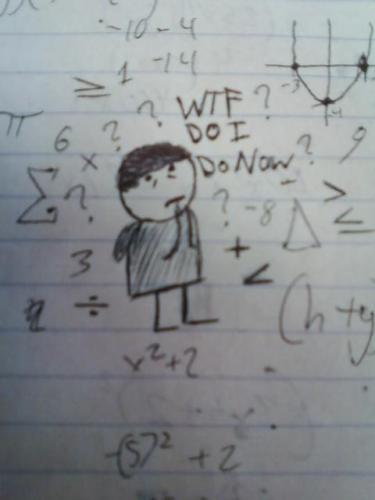
This is how many students feel about STEM.
Why? Because the deep psychological need that the arts fulfill for human beings is to provide access to new or difficult ideas. The arts give us an instinctual "vocabulary" or "set of tools" for thinking about confusing or unknown things. That's the deep-level reason why we do them at all: because the arts are an essential survival tool.

When the world confronts human beings with things we don't understand, what do we do? We hypothesize about them by telling ourselves a story about them, or creating a visualization, or singing or dancing how we feel about them, as seems appropriate.

How does that translate to the question of how we teach the STEM disciplines? Well, we seem to have trouble getting students to feel attracted to them, for one thing!

Generally, STEM materials look pretty dry. It's a consistent turn-off that
is totally unnecessary, in my opinion. We have ample ways to improve,
the teaching of Science Technology, Engineering and Math, using the arts.
Why do students resist the STEM disciplines, even when they are "required"? The reasons I hear most often tend to be that "they're hard," or "I don't understand them," or "they're boring!" (that last is often said with rolled eyes and a bit of a whine).

How better, then, to make them more accessible--even to those whose "primary intelligence" is not the "math/logical" one normally associated with those disciplines--than by using the tools that humans have developed over the ages as a survival necessity, precisely to help us successfully "fathom the unfathomable"?

How better to interface with the STEM disciplines, on ALL levels, than through the arts? Yet I can already hear critics attacking the idea for higher grades and college, for fear it will "lack rigor."

I long ago came to the conclusion that what most laypersons mean by "academic rigor" has little to do with in-depth critical thinking, and a great deal to do with memorizing longer lists of facts, dates, and equations, but it really seems to me that there is a prejudice in our culture, to the effect that if it's visual, then somehow it's been "dumbed down."

Roots of Human Behavior has unexpected depth--but
also "sells itself short," I fear.
A better realization of the depth that is possible with a visual-along-with-verbal approach came to me recently when I read/viewed a book titled Roots of Human Behavior by Viktor Reinhardt.

Published by the Animal Welfare Institute and clearly aimed at a popular audience, Reinhardt presents some basic--and not-so-basic--ideas about human and animal behavioral parallels, gleaned from his years of research, and he does it in a series of fascinating photos.

Unfortunately, the editorial staff for AWI seems to have bought into the idea of visual-as-dumbed-down, because Roots of Human Behavior sometimes reads like those sappy feel-good emails people send that end "if you care about someone pass this on to them" (you know the ones: they tend to have sparkly angels and animated GIFs).

However, the images themselves in this book are a great example of pictures conveying far more than could be explained with a great many un-illustrated words. I came to the end of the book with a weird feeling of having read something much deeper than it seemed to be--yet not as complete as it should have been.

I'd like to see a textbook on this subject, illustrated with exactly the same images. I bet even high school kids would be willing to put up with what they might otherwise have considered "boring" equations, tables, and technical definitions, if the textbook was illustrated with such a profusion of telling images.

As more educational materials go digital and interactive, I think we inevitably will see more and more visual and auditory approaches to material, in an effort to make them more interesting and accessible. We must guard against the tendency to "dumb down" the visuals, however. Let's use the arts (all of the arts) to help us get to the deepest thinking and the most profound understandings. After all, that's what they're designed to do!

_______________
*Note: Read more about the vital importance of early childhood literacy, especially as it applies to the African-American community, in the informative book, African Americans and Standardized Tests: The Real Reason for Low Test Scores, by Dr. Veda Jairrels.

IMAGE CREDITS: The image of the little boy with the early childhood literacy materials on the floor around him is courtesy of the award-winning Bernardsville (NJ) Library! Belated congrats, guys! (the award came in 2009).  The "math is hard" cartoon is from the Bilerico Project blog: an image worth 1,000 words, and aren't you glad I saved you reading them all? The collection of "dry stuff"--books, pages of equations, chemical formulas, etc., is composed of images from several sources. See the links in the previous sentence! Many, many thanks to all! I looked and looked online for a cover shot for Roots of Human Behavior, but eventually had to scan it for myself.