Showing posts with label Kansas City Crossroads Arts District. Show all posts

Tuesday, April 2, 2013

Fun in the Freight House Neighborhood-Part II

I had a wonderful day, between lunch with a good friend at Lidia's Kansas City, and a stroll through two of Kansas City's great small art galleries on Baltimore St. near the Freight House, in the southern part of the Kansas City Crossroads.

Julia Fernandez-Pol's Lily Pad Light is rich with texture.
The two galleries are similarly named near-neighbors, the Leedy-Voulkos Art Center, and Sherry Leedy Contemporary Art.  This entry focuses on my visit to Sherry Leedy's gallery.  In an earlier entry I talked about some fascinating artwork I found at Leedy-Voulkos.

The Texture Tour
The artwork that really spoke to me at this gallery all seemed to be playing with texture in one way or another. 

In the artwork of Julia Fernandez-Pol, it is the actual, physical texture of the oil paint, which I'd guess must have been applied with a palette knife, that is the most riveting aspect.

For me, the rich colors and textures in these images added up to a delicious visual feast that rewards the eye on many levels.

Mark Lyon's Michael Rees
The textures of Mark Lyon, on the other hand, are created as two-dimensional visual texture, and created in a most unusual way.  Lyon describes his evolution into using the "machine-assisted" "humidrawer" technique in an interesting essay on his website.

The artwork appears to be a large photograph, from a distance.  Move in closer, however, and you'll discover the amazing patterns within. 

My favorite, I think, was the portrait of Michael Rees (shown at right), because when I looked very closely, I realized the areas inside the eyeglass frames had been rendered like a spiral moving in from the frames to the center.

To give an idea of how these textures work, I pulled a couple of examples from Lyon's site.  These are two different renderings of an eye, one using only black lines, as in Michael Rees, and the other using both black and white lines on a toned surface.

Mark Lyons 2-D texture created with mechanical help: Left: black and white lines on a toned surface; Right black lines only. 
IMAGE CREDITS:  Many thanks to the Sherry Leedy Contemporary Art artist pages for the images of Julia Fernandez-Pol's Lily Pad Light and Mark Lyon's Michael Rees (click on the artist's name for images; the image pages themselves don't seem to have a URL).  The "eye detail" images are from Mark Lyon's website.  Many thanks for all!


Friday, March 29, 2013

Fun in the Freight House Neighborhood-Part I

It's been a great day, between lunch with a good friend at Lidia's Kansas City, and a stroll through two of Kansas City's great small art galleries on Baltimore St. near the Freight House, in the southern part of the Kansas City Crossroads.

Cactus Flower by Rhonda Nass, from Leedy-Voulkos.
The two galleries are similarly named near-neighbors, the Leedy-Voulkos Art Center, and Sherry Leedy Contemporary Art.  This entry focuses on my visit to Leedy-Voulkos.  In a later entry I'll talk about some fascinating artwork I found at Sherry Leedy.

Desert Fascination
The Art Center's Front Gallery is filled with wonderful images of desert wildlife (both flora and fauna) from the "Vanishing Circles" show.

The show features "portraits" of endangered or threatened species of the Sonora Desert.  It is presented in cooperation with the Arizona-Sonora Desert Museum.

Edward Aldrich's Brown Pelican
It is a departure from the Leedy-Voulkos' more usual type of contemporary art--more representational in a "realistic" manner.  But it does any organization good to "shake things up" a little bit, even if that means showing what some might consider more "traditional" art forms.

The 29 artists whose work is included in the show certainly present a visually gorgeous show.  The animals, from highly endangered pupfish to more widely-distributed ospreys and burrowing owls (whose habitat in the Sonora Desert is nonetheless disappearing), are beautiful, exotic, and presented by artists who know their craft deeply.  The desert plants, many rather bizarre-looking to midwestern eyes, become objects of awe and wonder in some of these artworks.

Otter by Sheridan Oman
Art of a Desert Recluse
Continuing the "desert theme" in an adjacent gallery is another collaboration between Leedy-Voulkos and the Arizona museum.

As a printmaking "major" back in the day, who is incorporating more and more printmaking concepts into my own art, I deeply appreciated the Sheridan Oman show. 

Oman worked at he Arizona-Sonora Desert Museum for several years before retiring to the desert to create engravings of desert animals on copper plates. 

He never had a show during his lifetime, but his monochrome prints fill the Opie Gallery at Leedy-Voulkos, and are well worth a close-up look.

The Art Center has several other shows running simultaneously with these.  Please see their website for more information.

IMAGE CREDITS: Many thanks to the Leedy-Voulkos Art Center for the images by Rhonda Nass and Edward Aldrich.  I am indebted to the Covington Gallery for the Oman "Otter."

Thursday, October 25, 2012

Not quite ready, yet!

Anton's wasn't open when we visited--but soon!
Several weeks ago I saw an article in the Kansas City Star (somehow the link is now gone!), about a new gallery above a restaurant in the KC Crossroads.

Called the Main Street Gallery, it was to be on the second story of a place named Anton's Taproom at 1610 Main, Kansas City, MO. The article said the gallery was open during the restaurant's business hours.

What fun, I thought, and made arrangements with a friend to have lunch there around the end of the month. Accordingly, my friend Nancy and I showed up there for lunch today.

However, we quickly found things had not progressed as rapidly as the newspaper article had led me to believe. Anton's sign was up, the lights were on, the door was open, and the proprietor was there with his work crew, busily trying to get the business ready to open sometime next week.

There's even art in the wine cellar, next to the herbs and tilapia.
He seemed happy to see us, even though he couldn't feed us, and eager to talk about his vision for the place, from the custom brews, to the aquaponics setup to grow fresh herbs and tilapia next to the wine cellar downstairs. "Go on down and take a look," he urged us, when we seemed interested.

So down the stairs we went, to startle another workman, and gaze speculatively at the herb seedlings sprouting from mats suspended over dark vats, which we assumed must contain (or be slated to soon contain) the promised tilapia.

The place may not have been officially open yet, but there was art a-plenty, even in the wine cellar. Paintings in a wide variety of sizes and styles hung from the walls--or, in a few places, leaned against them. There also were several 3-D works as well, including a couple of whimsical assemblages and a tableful of large, lathe-turned wooden pots.

We wandered around, enjoying the artwork, and also relishing the opportunity to share a small glimpse of the sublime state when exciting dreams have almost ripened into actuality.

Anton's Tap Room and the Main Street Gallery are going to be a very cool place. We felt specially privileged to see it just before the blossom opens.

This post was updated and corrected on Oct. 27, 2012.
PHOTOS: The two photos I've added were taken by me, Jan Gephardt, with my iPhone, on October 25, 2012, after receiving permission. See the Main Street Gallery's website and Facebook page for images of some of the artwork there.

Thursday, August 30, 2012

How Artists act as Urban Pioneers

Last month I wrote about a report from Americans for the Arts, which outlined the economic impact of the arts, particularly in my own hometown of Kansas City.

I also sketched in a few notes about artists as urban pioneers in Our Fair City: responsible for the current boom in what is now called the Kansas City Crossroads Arts District, and attempting similar neighborhood reclamations along Troost Avenue and in the West Bottoms.

Jim Leedy is still at work in the Crossroads Arts District of
Kansas City. He is the subject of a new film about his life.
A few days ago the Kansas City Star published a profile on a “first” pioneer of the Crossroads, Jim Leedy, who also is the focus of a soon-to-be-released film. Leedy is a former Kansas City Art Institute professor, and co-founder of the Leedy-Voulkos Arts Center. The Star article gives a more in-depth look at the work Leedy and his cohorts did, to create a nurturing place for new artists, and eventually bring economic renewal to what had once been a seedy warehouse district.

As in Detroit and other places badly impacted by the Great Recession, arts are providing an avenue for economic revitalization. Many states have begun to catch on. Even Kansas—where the infamous Governor Sam Brownback proudly demolished our Kansas Arts Commission, despite a bipartisan rebuke from the Legislature—has quietly instituted a new Creative Arts Industries Commission that replicates some of the Arts Commission’s previous role.

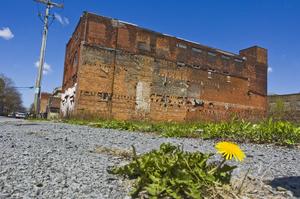
This crumbling warehouse in Utica, NY is the kind of place
where beginning artists might find cheap studio space.
The classic sequence goes like this: a low-rent district of dilapidated properties attracts artists, who go there at an early stage in their careers, in search of affordable studio space. 

Good places to look are warehouse districts that have fallen into disrepair, or down-at-the-heels business districts, where rents are low and nobody is too picky about a mess (art-making is generally not a drip-free, dust-free enterprise!).

This "Heidelberg Project" house offers an eye-popping
example of "visually interesting things in shared spaces."
Once they’ve established their studios, they collaborate, do visually interesting things with their shared spaces, and start putting on shows. People are attracted to this visually stimulating, offbeat creativity. They start coming frequently to see the art.

Other businesses notice that people are beginning to come to this area repeatedly, in ever-greater numbers. They develop a presence of their own, in this place “where it’s happening.” Business all over the area picks up.

Soon developers are offering “loft space” for urban-chic living, and the area becomes trendy. Gentrification is quick to follow, at which point the rents go too high for some of the artists, while others’ galleries are becoming more upscale, in tune with the neighborhood.

The ambiance of a successful arts district includes eateries
such as Benton Harbor, MI's Phoenix Cafe.
Now the original area is booming, still enjoying the “artsy afterglow” for several decades. Savvy businesses perpetuate the character of the neighborhood with sidewalk cafes, boutiques, and other interesting attractions, such as pocket parks, smaller, specialty museums, etc.

Meanwhile many artists have moved, looking for a low-rent district of dilapidated properties, where they can find affordable studio space . . . and the cycle begins again. 

PHOTO CREDITS: The Jim Leedy photo is by Rich Sugg of the Kansas City Star. The photo of the warehouse in Utica, NY is from the Utica Observer-Dispatch. The Ghost of Detroit Blog contributed the photo of the "Heidelberg Project" house in its blog post of the same name (couldn't find the photographer's name). The photo of the Phoenix Cafe in the Arts District of Benton Harbor, MI came from TripAdvisor.com's slideshow on the area.

Thursday, July 19, 2012

Stimulate the Economy! Yes, the Arts DO That!

The Kauffman Center for the Performing Arts, designed for
Kansas City by Moshe Safdie, is part of our vibrant
nonprofit arts scene. 
Two hundred seventy-three million dollars.

Eight thousand, three hundred and forty-six full-time jobs.

Nine million dollars of revenue to local governments.

Even to the One Percent, that isn't exactly chump change (though the Kansas-based Koch Brothers have spent far more this year on their political agenda).

To the rest of us, those numbers look dowright impressive.

According to an article published in today's Kansas City Star, a pair of studies by Americans for the Arts has calculated that my home town benefited to the tune of those impressive numbers in 2010, thanks to the economic engine that is the nonprofit arts community in our town. 


The Arts and Economic Prosperity IV Report seeks to measure the "quantifiable economic impact of nonprofit arts and culture organizations and their audiences." The Local Arts Index is new this year, and was designed "as a tool to better understand the characteristics of the cultural life of individual communities." 


Some other towns realized even more benefit, some less. But these reports tell--yet again--a story that should be clear to anyone who's been paying attention: far from being a "frill," the arts are economically important. 

Artists are often urban pioneers, spearheading renewal in run-down neighborhoods--just as they have done in the Kansas City Crossroads, and are attempting to do in our West Bottoms and on Troost Avenue. Arts and culture are an important factor in determining a city's "livability." They foster and enhance an environment where innovation, renewal, and growth builds a more vibrant tomorrow.

Yet still it's hard to get many people to see this value. Perhaps reports like the ones reported on today will begin to open a few more eyes.

PHOTO CREDITS: The beautiful image of the Kauffman Center is from a photo gallery of images posted on the Inhabitat website (I highly recommend you go look at them, and get to know the Inhabitat site; they have many wonderful things!).  I took the Crossroads photo, myself.

Wednesday, February 1, 2012

Dream Show


Specialty Rolled Metals
becomes an impromptu
gallery, May 5, 2011
Photo taken with permission.

I recently had a dream that I was in a vast maze of art galleries filled with people. We wandered wide-eyed past an array of paintings, sculptures, fiber pieces, drawings, pots, and other artworks in many different media.

When we looked at them, some of them would suddenly grow larger, or become more brilliantly colorful, or they would begin to glow.

Sometimes they came off the wall or down from the pedestal, to mingle and interact with us, to the delight of all.

Looking in the window of the
Arts Incubator from 18th Street in
the Kansas City Crossroads,
March 3, 2006.
Thinking about it afterward, it seemed to me that this dream offered an apt metaphor for the way I sometimes feel about viewing an interesting art exhibition.

One piece of art alone may “speak” to a person—but a whole, coordinated gallery full of artworks, curated around a theme, can sing in a wonderful chorus to an attuned viewer.

Make it a point to go look at some art soon: maybe you’ll find such a “chorus.”

PHOTOS: I took both of these photos during different First Fridays in the Kansas City Crossroads (see dates). They are available for use under a Creative Commons license, which specifies they should not be altered, and should be published with credit given to me as the photographer. 

Tuesday, February 8, 2011

Impractical Ideology Puts Arts Under Attack


Gov. Sam Brownback (R) 

The latest headline comes from Kansas today, where our new Governor Sam Brownback has just eliminated the Kansas Arts Commission

This comes right after a rules-change in the Department of Elementary and Secondary Education in neighboring Missouri, that has made school arts programs voluntary, not mandatory—and anyone who’s seen what a beating school budgets have taken recently, knows what that means.

This is a one-two punch in my own back yard—but no matter where you live in the US, the arts are under attack.  Joyless conservative ideology is trumping practical reality in state after state.

Yes, that’s right—practical reality.  What the arts-cutters don’t want you to know is that the arts don’t cost.  They PAY. 

First Friday crowd in the Kansas City Crossroads Arts District
As we've proved in the Kansas City Crossroads Arts District, in Cottonwood Falls, KS, and many other local and regional examples, artists are often pioneers for economic regeneration.   Moreover, on nearly every scale of a community’s “livability” and desirability, a vigorous arts community is a “must.”

A concert in Cottonwood Falls, KS draws a crowd.
Missouri’s backward attitude notwithstanding, there also is considerable research to show that a vigorous school arts program can dramatically improve the chance of success for at-risk students.  Participation in music programs is positively correlated with math excellence, for instance.  I guess all that is irrelevant?

And how about the lament among those who worry about America’s global competitiveness that we need more creative thinkers?  Where do you think we’ll find the best training and practice in creative thinking?

Eliminating support for the arts is the lamest kind of false “practicality.”  We can’t afford to fall for it.  Yet in state after state, it appears that we are.

Images: Sam Brownback from Polichicks website; KC Crossroads First Friday crowd by Jan Gephardt; Concert in Cottonwood Falls from Kansas Sampler Foundation website.

Monday, July 19, 2010

Should we call it the Leawood Arts District?

Something artistic is happening out there, and we should take note.

By "out there," I mean what many in the Kansas City Metro think of as "out there" in southern Johnson County, KS.

I'll be the first to grant that southern Johnson County doesn't exactly have a reputation for being stylish or artistic. Much of the artistic community around town tends to think of it with a What's the Matter with Kansas? frame of mind: as a wasteland of white-bread suburbanites in cookie-cutter plastic palaces.

If you think of it that way, however, you haven't been paying attention.

I recently attended the Johnson County Art Crawl, held Friday and Saturday, July 16-17, 2010.  Four of the five galleries on the itinerary are located in a relatively small area between 115th and 119th Streets, bounded on the west by Nall Avenue, and on the east by Tomahawk Creek Parkway--an area that I've started calling the Leawood Arts District. I couldn't get the link to Google Maps to work right, so I've included a screen shot.

A person in good walking shoes could have walked, Kansas City Crossroads-style, between the Prairiebrooke Gallery (A on the map), Eva Reynolds Fine Art Gallery (B), Leawood Fine Art Gallery (C) and The Rice Gallery of Fine Art (D).  However, unlike in the Crossroads, parking was not an issue, so it was easy to drive.  The fifth location was only a few blocks away, at the Tomahawk Ridge Community Center, which now hosts Overland Park's "Art at the Center" series.

There were no colorful crowds on the streets, such as you see on First Fridays in the Crossroads, but other aspects of the event compared very well.  The artwork I saw on display was easily equal to, or better than, much of what you typically see on a First Friday.  These galleries also had efficient air conditioning, decent wine, fresh hors d'oeuvres, and good live music.

The art on offer was a nice mix of local and nationally-known artists.  In several cases, the artists were both nationally-known and local!  Examples are the first Kansas City solo show by Michael Albrechtsen at the Rice Gallery, an exhibition by sculptor Tom Corbin at the Eva Reynolds Gallery, and several new, large paintings by George Jones, featured at Prairiebrooke.  "The Abstracts Exhibition," a collection of works selected by Friends of Overland Park Arts, was the attraction at Tomahawk Ridge, and a group show featuring work by many of the gallery's excellent artists was the focus at Leawood Fine Arts.

These five are by no means the only art galleries in Johnson County--nor are they the only good ones.  What should command the attention of every art lover in the KC metro, however, is the relative concentration of them in this fairly small area, and the uniformly high quality of the offerings to be found in the Leawood Arts District.

Thursday, July 8, 2010

Gallery Personalities

We know individuals have personalities that are uniquely their own, and that artists develop a recognizable personal style.

But I never was so clearly aware of how much a gallery can have its own individual style or personality, until recently. My husband and I were rambling through the Kansas City Crossroads Arts District when we encountered two examples of how distinctive a gallery’s “personality” could be.

The first was the new 2010 Gallery at 2010 Main Street, Kansas City, MO. We walked in and immediately “recognized” the wall colorings and characteristic groupings of images on the walls. After a few moments we recognized some individual artists’ work, as well. “Wait!” We both thought, “This looks like the Park Place!”
At left is the homepage for their website.  It gives a good idea of 2010 Gallery's look.

We’d been to the Park Place Gallery in Leawood, KS seven months earlier, but we knew it had closed soon after we were there. The “look” of 2010 Gallery was unmistakably similar. We later discovered that we’d been correct: this was the new “incarnation” of the same gallery. 2010, like Park Place, is the work of Tim Morrison and Rachelle Craig. We’re glad to see them back! 2010 Gallery is a strong new addition to the Crossroads.
At right is a screen shot of the Park Place homepage.  See the similarities?

The second wasn’t as much of a surprise—we already knew that Red Star Studios had moved from their former 17th Street location to the Belger Arts Center at 2100 Walnut St., Kansas City, MO. Red Star not only has gone through a change of location, but it also is transitioning to new ownership. The manager, ceramic artist Tara Dawley, brings consistency to the transition, because she also was manager and deeply involved in the “old” Red Star, owned by fiber artist Susan Hill.

The wide-open space at Belger is much different from the rather tight quarters of the old gallery space on 17th Street, but the display strategies are consistent. They feature white, neutral, or rich, finished-wood surfaces and 3-dimensional groupings to show off the work of the gallery’s ceramic artists.
At left is an example of a display in Red Star's old 17th St. gallery.  It shows the work of Mike Jabbur and Michael Fujita.


Red Star’s current show is “The Fundamentals of Clay,” featuring the work of Ted Adler and five Wichita State University graduate students:
 Nathan Carris Carnes, Lauren Clay, Todd Hayes, David Hellman, and Joe Leonard.  Work by two artists from the current show (Ted Adler at right, and David Hellman below) give an idea of this show's range.
Red Star Studios is a distinctive asset for the Kansas City arts scene. It consistently brings in work by top ceramic artists from all over the US and Canada (my apologies if their offerings are even more international than that!).  
According gallery staff and a conversation I had with Susan Hill at the Prairie Village Art Fair in June, the Belger Arts Center is not Red Star’s final destination. Ultimately, they will once again occupy their own space, somewhere else in central Kansas City. But for now they are alive and well at Belger, and we are glad for the chance to see their artists’ work again.  Anyone who is interested in the ceramic arts should pay close attention to their shows.


Discovering respected “old friends” in new places is a pleasant experience. I am excited to see both of these “old friend” galleries settling gracefully into the Kansas City Crossroads Arts District. I hope you will soon go see them for yourself!