Last month I wrote about a report from Americans for the Arts, which outlined the economic impact of the arts, particularly in my own
hometown of Kansas City.
I also sketched in a few notes about artists as urban
pioneers in Our Fair City: responsible for the current boom in what is now called
the Kansas City Crossroads Arts District, and attempting similar neighborhood
reclamations along Troost Avenue and in the West Bottoms.
 |
| Jim Leedy is still at work in the Crossroads Arts District of Kansas City. He is the subject of a new film about his life. |
A few days ago the Kansas
City Star published a profile on a “first” pioneer of the Crossroads, Jim Leedy, who also is the focus of a soon-to-be-released film. Leedy is a former Kansas City Art Institute professor, and co-founder of the Leedy-Voulkos Arts Center. The Star article gives
a more in-depth look at the work Leedy and his cohorts did, to create a nurturing place for new artists, and eventually bring economic renewal to
what had once been a seedy warehouse district.
As in Detroit and other places badly impacted by the Great
Recession, arts are providing an avenue for economic revitalization. Many states have begun to catch on. Even Kansas—where the infamous Governor Sam
Brownback proudly demolished our Kansas Arts Commission, despite a bipartisan
rebuke from the Legislature—has quietly instituted a new Creative Arts Industries Commission that replicates some of the Arts Commission’s previous
role.
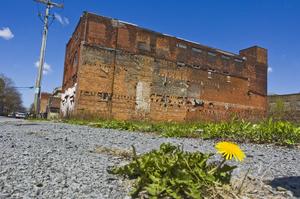 |
| This crumbling warehouse in Utica, NY is the kind of place where beginning artists might find cheap studio space. |
The classic sequence goes like this: a low-rent district of dilapidated
properties attracts artists, who go there at an early stage in their careers, in
search of affordable studio space.
Good places to look are warehouse districts that have fallen into disrepair, or down-at-the-heels business districts, where rents are low and nobody is too picky about a mess
(art-making is generally not a drip-free, dust-free enterprise!).
 |
| This "Heidelberg Project" house offers an eye-popping example of "visually interesting things in shared spaces." |
Once they’ve established their studios, they collaborate, do
visually interesting things with their shared spaces, and start putting on
shows. People are attracted to this visually stimulating, offbeat creativity.
They start coming frequently to see the art.
Other businesses notice that people are beginning to come to
this area repeatedly, in ever-greater numbers. They develop a presence of their own, in this place “where it’s happening.” Business all over the area picks up.
Soon developers are offering “loft space” for urban-chic
living, and the area becomes trendy. Gentrification is quick to follow, at
which point the rents go too high for some of the artists, while others’
galleries are becoming more upscale, in tune with the neighborhood.
 |
| The ambiance of a successful arts district includes eateries such as Benton Harbor, MI's Phoenix Cafe. |
Now the original area is booming, still enjoying the “artsy
afterglow” for several decades. Savvy businesses perpetuate the character of the neighborhood
with sidewalk cafes, boutiques, and other interesting attractions, such as pocket
parks, smaller, specialty museums, etc.
Meanwhile many artists have moved, looking for a low-rent
district of dilapidated properties, where they can find affordable studio space
. . . and the cycle begins again.
PHOTO CREDITS: The Jim Leedy photo is by Rich Sugg of the Kansas City Star. The photo of the warehouse in Utica, NY is from the Utica Observer-Dispatch. The Ghost of Detroit Blog contributed the photo of the "Heidelberg Project" house in its blog post of the same name (couldn't find the photographer's name). The photo of the Phoenix Cafe in the Arts District of Benton Harbor, MI came from TripAdvisor.com's slideshow on the area.


