Thursday, July 19, 2012

Stimulate the Economy! Yes, the Arts DO That!

The Kauffman Center for the Performing Arts, designed for
Kansas City by Moshe Safdie, is part of our vibrant
nonprofit arts scene. 
Two hundred seventy-three million dollars.

Eight thousand, three hundred and forty-six full-time jobs.

Nine million dollars of revenue to local governments.

Even to the One Percent, that isn't exactly chump change (though the Kansas-based Koch Brothers have spent far more this year on their political agenda).

To the rest of us, those numbers look dowright impressive.

According to an article published in today's Kansas City Star, a pair of studies by Americans for the Arts has calculated that my home town benefited to the tune of those impressive numbers in 2010, thanks to the economic engine that is the nonprofit arts community in our town. 


The Arts and Economic Prosperity IV Report seeks to measure the "quantifiable economic impact of nonprofit arts and culture organizations and their audiences." The Local Arts Index is new this year, and was designed "as a tool to better understand the characteristics of the cultural life of individual communities." 


Some other towns realized even more benefit, some less. But these reports tell--yet again--a story that should be clear to anyone who's been paying attention: far from being a "frill," the arts are economically important. 

Artists are often urban pioneers, spearheading renewal in run-down neighborhoods--just as they have done in the Kansas City Crossroads, and are attempting to do in our West Bottoms and on Troost Avenue. Arts and culture are an important factor in determining a city's "livability." They foster and enhance an environment where innovation, renewal, and growth builds a more vibrant tomorrow.

Yet still it's hard to get many people to see this value. Perhaps reports like the ones reported on today will begin to open a few more eyes.

PHOTO CREDITS: The beautiful image of the Kauffman Center is from a photo gallery of images posted on the Inhabitat website (I highly recommend you go look at them, and get to know the Inhabitat site; they have many wonderful things!).  I took the Crossroads photo, myself.

Thursday, July 12, 2012

Ancient Animations

   I was fascinated to discover an article in a recent issue of Science News, titled "Stone Age Artists Produced Movies," by Bruce Bower.
   Well, not movies as we know them.  But the Stone Age artists left rudimentary animations on the walls of several European caves. Archaeologist Marc Azema (University of Toulouse-Le Mirail, France), whose work was spotlighted in the Science News article, has created a wonderful animation, showing an interesting collection of them (via YouTube):


Archaeologist Marc Azema has created several films on cave
art animations.

   Azema has been involved in a number of film and animation projects, and has been a presenter at the Annecy International Animation Film Festival as well as other places.
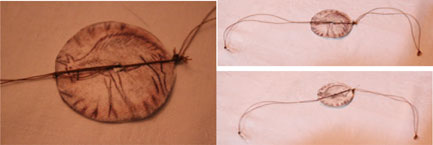
   The Science News article also included photos of a bone disk, engraved on both sides (one shows a standing deer, the other a deer with its legs drawn up under it). Stringing an animal sinew through a hole drilled in the middle and spinning it creates an optical illusion of the deer jumping or lying down (depending on your interpretation).
   This is called a thaumatrope. The idea was re-invented in the 19th century; thaumatropes were popular toys in Victorian times, but not many realized until recently that Stone Age Europeans used them too. 
   I took the images of both sides of the bone disk, using photos printed in my copy of the magazine, glued them to cardboard, and tied them with upholstery thread to simulate the sinew.  It works pretty well.
I hope you can see the images on my homemade thaumatrope, made from photos
originally published in the print version of the Science News  article. 
   A much more recent animation was discovered on a 5,200-year-old Iranian cup--until recently thought to be the world's oldest animation (though it can't compete with Chauvet Cave's 30,000-32,000-year age). I have been unable to get my Blogger interface to let me embed the "jumping wild goat" animation (Go to Major Durant's Photobucket page to see that), but here's a look at the sequence of images on the footed bowl/cup:
Here is the sequence painted along the rim of the 5,200-year-old bowl.
An archaeologist holds the ancient bowl in a CHN photo.
I had a great time looking at these, and I hope you enjoy them, too!


PHOTO CREDITS: Many thanks to Marc Azema for the YouTube video of the cave animations. The photo of M. Azema in his element is from the Annecy International Animated Film Festival's online 2012 archive. My son Ty Gephardt took the photos of my homemade thaumatrope. The images from the rim of the Iranian bowl are from the Circle of Ancient Iranian Studies website, and the image of the bowl itself is from T. Lee Harris's "Comments from the Peanut Gallery" blog. My gratitude goes to all! Please go look at their sites for more cool information.

Thursday, July 5, 2012

A Meeting of Minds . . . and Media


Karin L. Frank's chapbook, A Meeting of Minds,
is full of beautiful, intellectual poetry . . . and
also my artwork!

Last winter I had a pleasant opportunity to create a series of ink drawings to illustrate a poetry chapbook by a friend of mine, Karin L. Frank.

My first thought, when my friend approached me, was, “a poetry chapbook? Seriously?”

Ah, but then I read the poems.

Several had already been published in other—as in, “mainstream”—print media, such as the Kansas City Star or Isaac Asimov's Science Fiction. 

I’d already known that my friend wrote interesting science fiction (prose), but the marriage of sophisticated science concepts with the poetry art form produced something rich and extraordinary indeed.

Karin titled her chapbook A Meeting of Minds: Poems from the Two Cultures, a reference to C. P. Snow’s concept of the sciences and the humanities as being two different “cultures” in “the intellectual life of the whole of Western Society.”

My holistic view of the world sees the two as integrally linked as the sides of a coin—not a strange thought to science fiction readers and writers. But the rest of Western society appears to see more of a chasm between the two.

If a chasm exists, however, these poems bridge it to elegant, often humorous satisfaction. Poetry is too seldom appreciated, these days, unless it is in the form of song lyrics. I hope some of my readers will find it worthwhile to click the Amazon link or go to Wolfweyr and open Karin’s rich vision for themselves.

Meanwhile, she’s authorized me to offer a sample:

Ecological Niche
She finds her level
on a suitable tree
where sunlight strikes,
nestles at the spot
where grubs grow plump
for baby birds,
nurtures and grooms
until wings feather out
and flocks of fledglings depart.
She remains and ripens.
Matured, plumage
reverted to scales,
she slithers down the tree,
and returns to earth.


Topological Twist
A torus and a cup
are alike to a topologist
but it’s messy
when I try to
Drink tea
from the doughnut
I’m dunking in it.


IMAGE CREDITS: Cover design is by Jan S. Gephardt, © 2012 by Honey Bee Publishing, and used with permission. Both interior illustrations are © 2012 by Jan S. Gephardt.

POETRY CREDITS: “Ecological Niche” and “Topological Twist” are © 2012 by Karin L. Frank, all rights reserved, and are reproduced here with the author’s permission. Please contact Honey Bee Publishing, P.O. Box 404, Odessa, MO 64076, for further information.

A Meeting of Minds: Poems from the Two Cultures is available from Amazon or directly from Honey Bee Publishing, via Karin's blog Wolfweyr.

Thursday, June 28, 2012

Shadow Focal Length


I don’t remember consciously noticing that shadows have what you might call a “focal length,” until a few years ago.

This 18th-century Epergne by Thomas Pitts I is in the
Folgers Collection at the Nelson-Atkins Museum of Art.
I was enjoying a long, detailed look at the intricate baskets and trays of the amazing 18th-century Thomas Pitts I Epergne at the Nelson-Atkins Museum of Art, when I became fascinated by its shadows.

Some of the shadows, cast by lower parts (closer to the surface on which it stood), were dark, sharp-edged shapes. These shadows clearly showed the multitude of intricate openings (they appear to have been blurred and softened in the official photo published online).

The taller parts, however, cast paler, fuzzier shadows. I never realized shadows had depth of field, I thought. The piece is a beautiful and amazing tour de force in its own right, but that day I was even more entranced by the shadows.

Leaves from different levels on the tree cast sharper or
blurrier shadows depending on their distance from the street.
I’ve since had an opportunity to notice this effect in other places, most notably in the shadows of trees in my neighborhood when I walk my dogs.

It’s been so hot lately that I’ve taken to walking after dark, when it’s cooler. The streetlights on the leaves create a very similar effect to the one I remember observing at the Nelson-Atkins, and I managed to get some photos.

PHOTO CREDITS: The image of the Thomas Pitts I Epergne is courtesy of the Nelson-Atkins Museum of Art in Kansas City, MO. The photo of the leaf shadows is by Jan S. Gephardt, taken in June 2012 in Westwood, KS, and may be distributed online under a Creative Commons license, providing it is not altered and credit (preferably with a link back) is given. 

Thursday, June 21, 2012

Nudity and Public Art


Yu Chang's sculpture recently
caused a furor in Kansas City (Photo by
Fred Blocher, for the KC Star).

“Being unclothed is not the equivalent of lewdness,” I wrote in a Letter to the Editor recently, but unfortunately many people persist in seeing it that way—and it has an impact on artists.

In Kansas City recently, we've been wading through yet another controversy about nudity in public art. As readers from outside KC may be aware, and as my home-turf readers can readily testify, both Kansas and Missouri are very socially conservative states.

This is not to say that people around here cannot be well educated or sophisticated. But the echoes of the 19th-century Holiness movement, with its cultural wariness about anything “worldly,” still reverberate loudly around here.

The focus in Kansas City at this moment is a sculpture in the Overland Park Arboretum. Chinese artist Yu Chang’s sculpture, Choice: Accept or Reject would not at first seem much of a candidate for a charge of immorality: the poor woman has lost her head, and is coming all to pieces over taking a photo of herself.

The work strikes me as being rather far from sexy or sensual. I think it would be more appropriate to see the nudity as expressing vulnerability to self-esteem issues.

The message of Pray Standing by Arden Ellen Nixon
has little to do with sexuality!
This episode has brought to mind another recent experience. I am the Art Show Director for the annual ConQuesT Art Show, held in Kansas City each Memorial Day Weekend.

One of our exhibitors, Arden Ellen Nixon, is unfortunately all too familiar with the heavy-handed censorship that can come from a misunderstanding of nudity in art. She queried me beforehand, about the acceptability of some of her images for the show. “Do I need to engineer some painter's tape pasties, or are [these] pieces acceptable as is?” she asked.

The pieces in question needed no “pasties,” as far as we were concerned. She sent them, we exhibited (and sold some of) them, and not a single word of complaint came to anyone on the Art Show staff. Compliments, yes—complaints, no.

To me, her work makes expressive use of nudity as a metaphor for spiritual concepts, as in Pray Standing, the work she gave me permission to share here. I really love this piece. It speaks to me of standing in complete openness before the Creator—a powerful message that we could not receive without the nudity of the central figure.

To get into a dither over exposed “boobies” is something most adults should hope to have moved beyond when they made it to high school . . . and yet, the petition to remove the sculpture still gathers signatures. 

How much better to simply confront the artwork, and let it speak to you with its own visual vocabulary!

IMAGE CREDITS: The photo of Yu Chang’s sculpture is by Fred Blocher, and was published through the Kansas City Star’s “Johnson County 913” magazine. Pray Standing is shown here courtesy of the artist, Arden Ellen Nixon. See more of her work on her website. 

Monday, April 23, 2012

Pieces of Art


Here's a Glimpse of Two Projects-in-Progress
I have been exploring new ways to make paper sculpture this year. I am coming up with some things that look cool to me . . . but so far I'm having difficulty completing a full composition. Here are the pieces I've made:


"Black-Headed Heron"
While doing research for a piece I am making for a private client, I discovered these wonderful, utterly gorgeous birds!
I had a lot of fun making this Black-headed Heron! But how to handle his background?
Black-headed Herons are indigenous to Africa, and live alongside hippos, alligators, anhingas, and many other species that inhabit riverbank habitats. I found some excellent resource photos on the Internet, and from them I developed a prototype drawing from which I could create "pattern pieces" for this assemblage.

This heron is made up of about 18-20 different pieces of paper. I think he turned out looking pretty decent, but all of the backgrounds I've tried to make so far look--pardon the expression--crappy.

"Horsefeathers"
Yeah, yeah, it's not very original, but it'll do for a working title.

This one originated with the wing. You might note the similarity to the Heron's wing, above. I used the same pattern, then added another row of feathers, to make it look more in proportion to the horse.

I was thinking about the heavy hair on some horses' feet, also called "feathers," and my fantasy artist side just couldn't resist playing with the obvious next thought.
So far, none of my backgrounds "work" for him, any better than the would-be backgrounds for my Heron.
Unfortunately, all of my attempts to give this guy a background that "works" for him also have been epic fails. 

The horse, by the way, is a somewhat simpler piece than the heron, though created via the same basic approach. There are only about 16 pieces to him.

The Reality-to-Unreality Balance
It is proving very difficult to come up with a background that can be executed with exactly the same balance of realism-to-unrealism as that of the "central figure." If the balance is off, the composition has no unity, and the whole illusion falls apart.

Part of the time I think the work I've done possibly could stand on its own as "complete," with just a solid-color, neutral background. Part of the time I don't think that would be enough.

Suggestions, anyone?

IMAGE CREDITS: Both images are photos I took of my own artwork. Both may be used on blog posts as long as they are not altered, and full credit with a link back to this post are given. Otherwise, all rights are reserved by Jan Sherrell Gephardt, (c) 2012.

Friday, March 23, 2012

Creative Uses for Quilts!

     My sister, Gigi Sherrell Norwood, is an amazing quilter (perhaps I can do a spotlight on her work in this space sometime), and I have loved and admired quilts all my life. Their normal uses are wonderful enough, as sort of the first wave in on-site recycling--not to mention treasure-repositories of memories, and beautiful, warm bedding.
Hausa horse armor--photo from the Smithsonian Archives.
     But quilts also have been used in a variety of other ways. There apparently is a tradition in the African-American cultures of designing them to help with healing or ward off evil.  
     I was fascinated with the "code" in quilts that was supposed to have been used by travelers on the Underground Railroad (I believe that idea has been questioned by other historians, but it's still a way-cool idea).
     Some of the most unusual quilting projects I've ever seen are their uses as what I can only categorize as "vehicle coverings."
     Let's start with traditional Hausa horse armor. I had seen a photo of a man on his horse, years ago in a textbook, and only recently re-encountered images on the "Diamonds and Wood" blog, published there courtesy of the Smithsonian Archives. 
More Hausa horse armor--and no heat stroke!
     The Smithsonian material says, in part: "Heavy garments of quilted cotton cloth stuffed with capok were widely used as armour for horse and man in central and eastern Sudanic Africa. In the Sokoto caliphate of northern Nigeria, heavily armed horsemen in quilted armour were known as Yan Lifida. They often acted as the bodyguards of an Emir on the field." 
     One would think both horses and riders might get too hot--but I suppose it's better to be very warm than dead from enemy arrows. 
     And they really do look splendid. I can't help being struck with the similarities between the patterns in the armor the horses are wearing, and the patterns of some of the quilts I've slept under!
This quilted cover for a VW Beetle was made for a quilt sho
by the Northwest Quilters of Portland Oregon. 
     So far, all of the uses for quilts that I've mentioned have been practical (to one extent or another). I'm not sure you could say that of these next ones! Fun? Definitely. Practical? Not so much.
     The first is a "Quilted Car"--actually a custom quilted cover for a Volkswagen Beetle. It was made by Northwest Quilters in Portland, OR, for a quilt show in 2010. I found a photo of it on the Flikr Photostream of "Quiltinkimmie," a.k.a. Kim Burley. 
The "Quilted Golf Cart" of the Palmetto Quilt Guild
of Hilton Head, SC.
     The second is one it took me a while to track down. I originally saw the "Quilted Golf Cart" in a quilting magazine, the Quilter's Newsletter, in 2005. After some online investigating and several emails between myself and Linda Solis, the president of the Palmetto Quilt Guild of Hilton Head, SC, and was sent some good pictures of it, taken by Doo Weidman of the Guild.
     I've included the better of them here. What impresses me most about the golf cart is that it not only has an astonishing array of different quilt block patterns (as does the VW above it), but they even created a quilted cover for the steering wheel shaft! I thought the fringe was a nice touch, too. It sort of evokes the "surrey with the fringe on top" from the musical Oklahoma!
     I think if I can draw any generalizations from this post and its eclectic collection of patchwork permutations, it is that quilters are very creative folk.
     And always have been!


PHOTO CREDITS: As noted, the images of the Hausa horse armor came from the Smithsonian Archives via the "Diamonds and Wood" blog, the "Quilted VW" from Quiltinkimmie, and the "Quilted Golf Cart" from Doo Weidman of the Palmetto Quilt Guild, with the gracious help of Linda Solis. Many, many thanks to all!